
For players who know the theory and still get lost in the changes
Play through “All the Things You Are” starting a line from any note.
53 workouts. One scale degree a day. $97 this launch week, and the price only goes up.
A simple weekly routine from Nick Homes, who has taught jazz for almost 40 years. It turns the harmony you already understand into lines you can actually play, on the most important standard in jazz.
The $97 price ends in
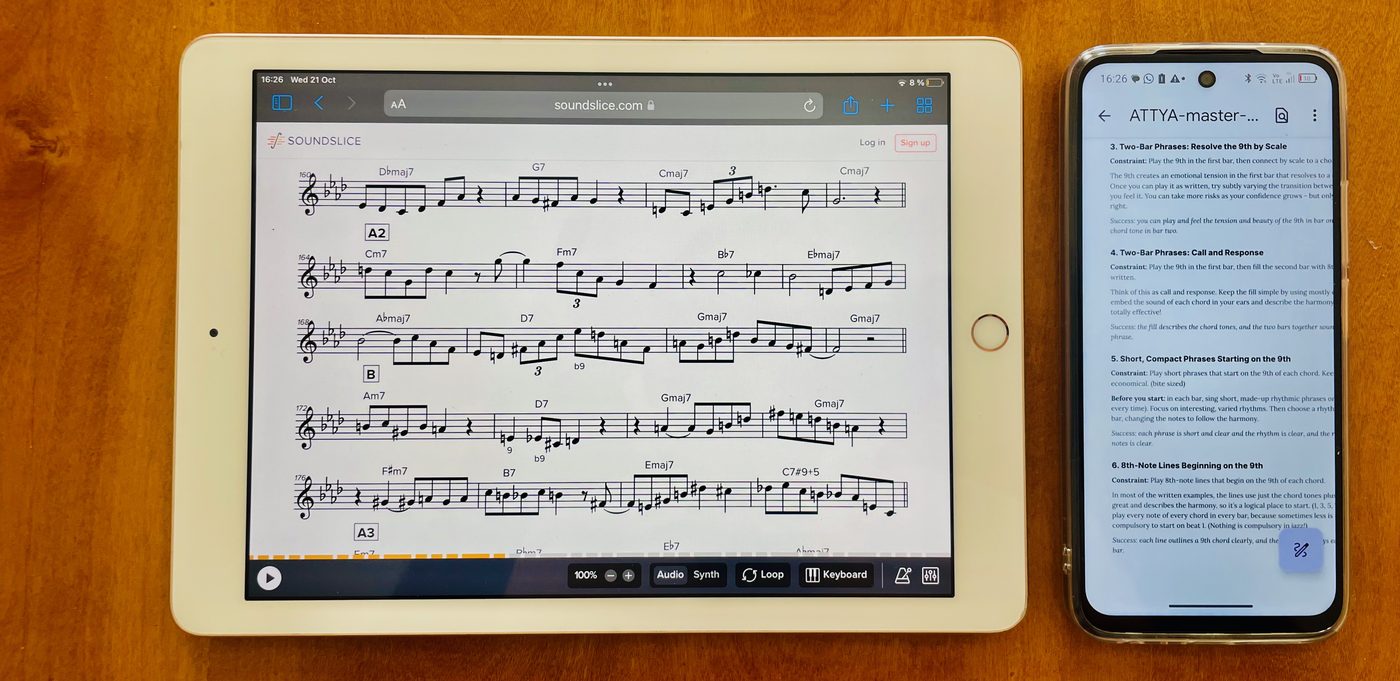

Inside the masterclass: the score and band on one screen, the master notes on the other.
30-day Proof-of-Practice Guarantee · instant access · Concert, B-flat and E-flat
No discounts and no codes. The price only goes up.
The workouts run in Soundslice, the player used by Berklee Online, Carnegie Hall and TrueFire.
See one lesson before you decide
A demo class from the masterclass, then a real workout you can play today.
Try one workout yourself, on the 9th: play the 9th in the first bar, answer it in the second.
Try the 9th workout in SoundsliceOne course, one week, three prices. Here's the whole thing.
The people who decide first pay the least. Nobody who pays full price later sees it marked down the following week.
Launch price
Second half of launch week
Regular price
Doors close Sunday 1 November at midnight, New York time. After that, the masterclass stays on sale at $147.
You have the knowledge. It just doesn't come out when you play.
You know your scales and your arpeggios. You can explain a ii-V-I. And then the tune gets to the bridge, the key changes again, and you are back to the same handful of licks, starting from the same safe notes. Or you are simply lost.
It is not a lack of information. Most adult players Nick teaches have too much of it: too much to think about while they play. Every new book and every new video adds to the pile, and the pile is what gets in the way.
You've probably tried:
- Another book of scales and patterns, read once and put on the shelf.
- More videos, each one adding one more thing to think about on the bandstand.
- A collection of licks, which sound like licks the moment the changes move.
- "Just listen and it will come." For a few people who started at twelve, maybe. For most adults it never does, and that is not your fault.
So you practise harder, on more material, and a year later the changes on "All the Things You Are" still feel like something to survive.
Start on Monday. One scale degree a day.
One or two workouts in one sitting. The same weekly loop, four times a month, until the notes you used to avoid are the ones you start from.
Day 1, the root
Log in, open Module 1, then play your first workouts from the root of every chord. One sitting.
One full week
You have started phrases from all seven scale degrees, on the real changes.
Four full passes
Every degree four times. The 13th and the b13 sound different in your own playing.
Any standard
Analyse, take it in slowly, one degree a day. The same steps work on the next tune you learn.
What changes for you
After your first week
- You have started phrases from all seven scale degrees, on the real changes
- You know exactly what to practise tomorrow, and it takes one sitting
- You have heard the difference between the 13th and the b13 in your own playing
After the course
- Start a melodic phrase from any scale degree: root, 9th, 4th, 13th, all of them
- Play with confidence over major, minor and dominant chords through the whole form
- Build your own vocabulary of lines that comes from the harmony, not from memorised licks
- Apply the same method to any standard you play
Picture the next time someone calls this tune. The bridge arrives, and you are not counting keys. You pick a note you used to avoid, and a line grows out of it.
The great players can start a line from any note of the chord. Most of us start from the same three.
The usual approach
Learn more. More scales, more licks, more theory, more listening. Each new thing goes on the pile, and on the bandstand the pile is exactly what you can't think through. You end up starting from the root, the 3rd and the 5th, because those are safe.
The Creative Constraint Concept
For one day, you start and develop every idea from one scale degree only. That limit gently corners you into sounds you would never normally play. The next day, the next degree. After seven days you have lived inside every note of the harmony, and the week begins again.
- Day 1RootFeel how solid it is
- Day 22nd / 9thEvery line starts here today
- Day 33rdThe certainty of the chord
- Day 44th / 11thThe note most players avoid
- Day 55thOpen and stable
- Day 66th / 13th13th or b13, you hear the difference
- Day 77thThe pull to the next chord
Nick learned Spanish at 39, in Buenos Aires. You learn a few words, then how they fit together, then you say them out loud until you stop thinking. This masterclass is that, for one tune.
That method is the whole course. Here's what it looks like from the inside.
Here's what's inside the masterclass
Five modules, each with a clear job. Take them in order, or go straight to the workouts if you cannot wait to play.
Introduction and Orientation
The Creative Constraint Concept explained, your learning goals, and a walkthrough of the Soundslice player so you can use every feature from day one.
Harmonic Foundations
A clear analysis of the chord progression: how it is built and why it moves the way it does. So you always know where you are in the tune, even if you do not play piano.
Preparation Exercises
Slow exercises that put the colours of the harmony into your ear first, so the core workouts feel natural and not overwhelming.
The Core Workouts
53 workouts across the seven scale degrees, from the root to the 7th. Some degrees need five, some need ten, because each one is a world of its own. Each one applies a different constraint: guide tones, bebop scales, chromatic enclosures, jazz language, rhythmic shifts, chordal approaches and embellishments. The module opens with a teaching video, and each set starts simple and musical, then grows.
The Coda
For when you want to go further. It opens with a first set of extras and grows after launch. Everything added later is yours at no extra cost.
Every workout comes with
- A synced scoreNotation that follows the audio, on any device. Slow it down, loop a bar, transpose.
- A recorded demoPlayed for this exact workout, so you hear how it should sound.
- Master notesWhat to focus on, in plain words, ending with a clear test of success. Also as a printable PDF.
- A backing trackMute the sax and play with the band. Also as an MP3.
- Notes on the scoreAnnotations right inside the music, where you need them.
- Print it in your keyTranspose for B-flat or E-flat in one click, then print.
10 places only
Guided: Nick listens to you play.
Everything in Standard, plus personal feedback from Nick on your own playing.
- Send Nick three videos or audio recordings of your practice (up to 10 minutes in total) within 8 weeks
- A personal reply to each one within 7 days: written notes plus a short audio message where Nick plays what he means on the sax
- Specific next steps for your playing, not general advice
- Where it helps, one of Nick's practice books, picked for what you need
One payment. The price does not change during launch week. When the 10 places are gone, Guided closes.
Take a Guided placeA private consultation with Nick is $1,000. A Guided place is the most affordable way to have him hear you play.
"You don't need to be a prodigy. You do need curiosity, patience, and seriousness of intent."
The artist's blueprint
Think of the constraints not as rigid rules, but as frames in which you sketch the blueprint of your own sound. Each day has its scale degree. Inside it, you choose the workouts that pull you in. If you gravitate toward guide tones, you are probably a melodic player. If you thrive on dense chromatic lines, you lean contemporary. The hardest ones will give you the most, and there is no rush.
Chet Baker and Miles Davis were not the most technically dazzling trumpet players of their time. It didn't matter. They had a voice you recognise in two notes. You choose what you practise, and what you practise becomes who you are as a player.
Why this tune
"All the Things You Are" is one of the very few standards that uses every note of the chromatic scale as a chord root. Cycle-of-fifths movement, ii-V progressions, modulations, pivot chords: it is all in there. If you can move through this tune, you can find your way through almost any standard.
What players say about learning this way
From Jazzduets customers and students of the Chromatic Enclosure Lab, which uses the same Soundslice workouts.
★★★★★"Some people are obsessed with being recognized, with fame. Nick is obsessed with people learning what he knows, with teaching you how to do what he does. He enjoys giving you tools to make your musicianship better. Do you know how rare that is? If I could give it a hundred stars I would."
Gonzalo, Jazzduets customer review
★★★★★"I am blown away by how much detail is included in each lesson, and the built-in facilities enable me to alter the tempo and learn at my own pace. The content exceeds anything I have experienced in other jazz tuition resources."
Eddie, student of the Chromatic Enclosure Lab
★★★★★"Each lesson is lucidly explained and perfectly portrayed. The Soundslice interface enhances the ease of operation and makes every exercise enjoyable."
Alan, student of the Chromatic Enclosure Lab
★★★★★"Nick's approach here is unlike anything I've seen in the world of jazz teaching materials. The combination of the clear, practical content with the Soundslice player makes it easy to practice efficiently."
Scott, student of the Chromatic Enclosure Lab
PROOF OF
PRACTICE
The Proof-of-Practice Guarantee
I stand behind the Creative Constraint Concept. Do the work and you will hear it in your playing.
Take 30 days from purchase. If you have practised the constraints and you have not experienced concrete growth, email me a short video of yourself playing any one of the course exercises from the 2nd, 4th or 6th degree, from memory over the backing track, and I will refund every penny. No argument, no hard feelings.
Why the video? Because the Creative Constraint Concept only works if you practise it. I am not judging how well you play. I only ask that you tried.
This applies to both Standard and Guided. For Guided students, the guarantee ends once you send your first recording for feedback.
Two ways the next jam session goes
If nothing changes
- Someone calls "All the Things You Are" and you hope it isn't at a fast tempo.
- You start from the root and the 3rd, because those are safe.
- The bridge modulates and you count keys instead of listening.
- You buy another book, and the pile gets taller.
With the masterclass
- You have spent weeks inside every degree of this exact tune.
- You start a line from the 9th or the 13th because you have done it every week.
- You know where you are in the form, even through the key changes.
- You use the same steps on the next standard you learn.
The difference isn't talent. It's one clear routine, one degree a day, started this week.
This is for you if
- You play your instrument at an intermediate level
- You struggle to connect your lines smoothly through the changes
- You want practical exercises that sound like music
- You want to know how serious players actually practise a standard
- You want one clear routine, not more material
It is not for you if
- You are just starting on your instrument
- You want a collection of hot licks to memorise
- You want a different tune every week
- You are looking for theory to read, not something to play
- You can't find 20 to 30 minutes a day to practise
- You want a quick fix and aren't willing to do the work
Questions people ask
Is this too advanced for me?
If you can play your instrument at an intermediate level and read a lead sheet, you can do this. Each set of workouts starts simple and adds one thing at a time. The preparation module exists so the core workouts never feel like a wall.
What is Soundslice?
It is the interactive player the course runs on: the score moves with the audio, and you can slow it down, loop a bar or change the key. It works on any device, in your browser. It is the same player used by Berklee Online, Carnegie Hall and TrueFire.
Which instruments is it for?
All of them. The Soundslice player transposes every workout for B-flat and E-flat instruments, and you can print the score in your key.
How much time do I need?
One scale degree a day. Pick one or two workouts from that day's degree and stay with them. A short, focused session every day beats a long one on Sunday.
How do I get access?
Straight away. After checkout you receive an email with your login to the Jazzduets course site, and the masterclass is waiting there. The backing tracks can be downloaded as MP3s, and the master notes as a printable PDF. Your access does not expire, and corrections and additions appear automatically.
Why does the price go up?
Because Nick does not do sales. The people who decide first get the best price, and nobody who pays full price later sees it marked down the following week.
How does the Guided place work?
You record yourself playing a workout, on video or audio, and send it to Nick. Three recordings within eight weeks of joining, up to 10 minutes in total. Within 7 days he replies with written notes on what he hears and what to do next, plus a short audio message where he plays what he means on the sax. Where it helps, he also sends one of his practice books, picked for what you need. There are 10 places because that is how many players he can answer properly.


Your teacher
Nick Homes
Nick has been teaching jazz for almost 40 years, and Jazzduets is where that teaching lives.
When he moved to Argentina at 39 he had to learn Spanish from nothing. It felt huge, overwhelming, and some days humiliating. It is exactly the wall he sees adult students hit with improvisation: too much information, too much to think about. Everything he makes now has one aim, the clearest and most friction-free path into jazz he can build.
This masterclass is that idea applied to the most important tune in the repertoire.
Launch week runs until Sunday 1 November. Here's everything you get.
Until Wednesday at midnight, New York time, the masterclass is one payment of $97. From Thursday it is $117, and from Monday 2 November $147.
The All the Things You Are Masterclass includes:
- All five modules: from the harmonic analysis to the Coda
- 53 core workouts: each with synced score, demo, master notes and backing track
- The 7-day practice plan: one scale degree a day, four passes a month
- Video lessons throughout the course
- All instruments: Concert, B-flat and E-flat, printable in your key
- Lifetime access, including every correction and addition
- 30-day Proof-of-Practice Guarantee
$97 Mon to Wed · $117 Thu to Sun · $147 from 2 November
$97
Join the masterclassSecure checkout on jazzduets.com. Your login arrives by email straight after.